

This guide walks you through downloading, installing, and launching Polyphon for the first time.
Requirements
- macOS 13+ on Apple Silicon (arm64)
- At least one voice provider configured — either an API key or a supported CLI tool in your
PATH
Download
Download the latest release from polyphon.ai.
| Platform | File |
|---|---|
| macOS (Apple Silicon) | Polyphon-*-arm64.dmg |
Install
- Open the
.dmgfile. - Drag Polyphon to your Applications folder.
- On first launch, macOS may show a security prompt — click Open Anyway in System Settings → Privacy & Security.
First Launch
When you open Polyphon for the first time, a welcome dialog appears. This is your chance to set up your conductor profile — how voices will address you — before starting your first session.
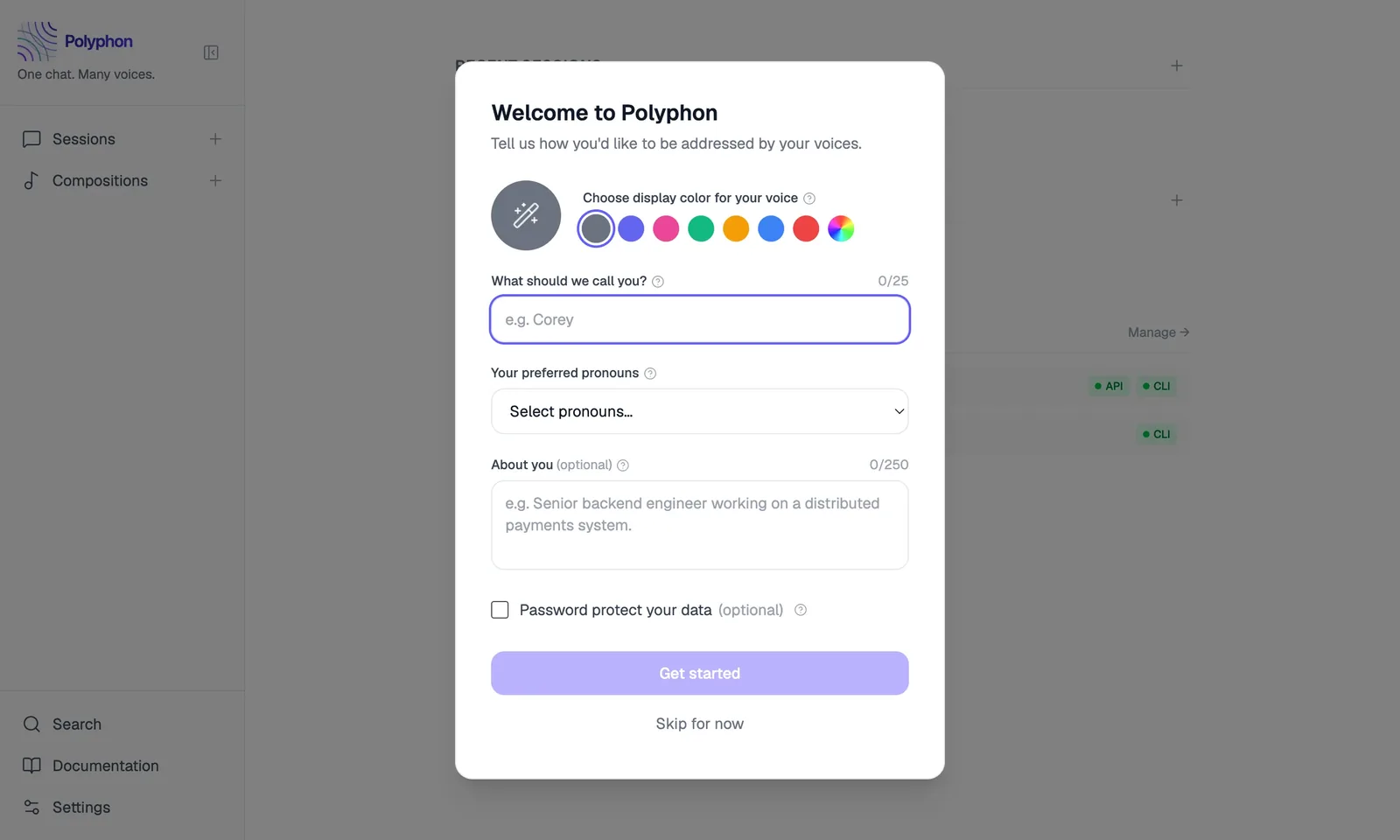
The welcome dialog lets you set:
- Avatar — click the circular button to upload a photo. After selecting a file, the crop editor opens so you can reposition and zoom the image before confirming. The avatar appears in the sidebar next to your name.
- Name — how voices address you (up to 25 characters). This field is required to click Get started.
- Pronouns — your preferred pronouns, injected into every voice’s system prompt. Optional.
- About me — free-form background context (up to 250 characters). Optional.
Click Get started to save your profile and open the main window. Click Skip for now to proceed without setting a profile — you can configure it later in Settings → Conductor Profile.
After the welcome dialog, you will see the main window with an empty sidebar. Before starting your first session, you need at least one voice provider configured. Go to Settings (gear icon in the bottom-left corner) and add your first provider.
See Voice Providers for step-by-step instructions.
Build from Source
If you prefer to build Polyphon yourself:
git clone https://github.com/polyphon-ai/polyphon.git
cd polyphon
npm install
make dev        # run in development mode
make build      # build a production binary
Requires Node.js 24+ and npm.